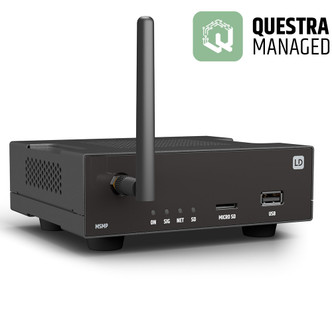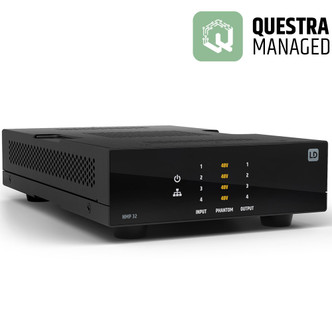
NMP8 and NMP32 are not intended to be “small vs. large” versions of the same processor.
They are two specialized tools within the same platform, designed to work together or
independently, depending on the project requirements.
The core idea of the NMP platform is:
Distribute DSP power and system scaling exactly where it is needed — not everywhere.
Simple way to understand NMP8
NMP8 is the processing brain of the system. It focuses on sound quality, sound conditioning, and DSP-intensive tasks.
Simple way to understand NMP32
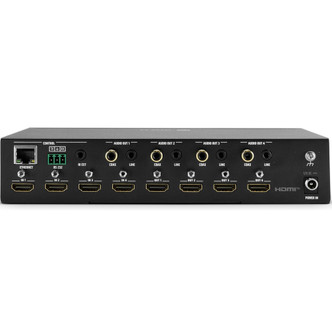
NMP32 is the system backbone. It focuses on scale, distribution, and flexibility rather than per‑channel DSP Depth.
Why are both devices priced the same?
At first glance, the identical price can be confusing. However, both products deliver comparable
value — in different dimensions.
NMP8: Value through DSP depth
* High DSP consumption per channel
* FIR and AEC are among the most DSP‑intensive features in professional audio
* Optimized for quality and processing flexibility
NMP32: Value through DSP breadth
* Much larger matrix (32×32)
* Significantly higher routing complexity
* Designed to scale systems efficiently
In simple terms:
* You pay for DSP power per channel with NMP8
* You pay for DSP scale and system size with NMP32
Both products address the same professional price segment, but serve different system tasks.
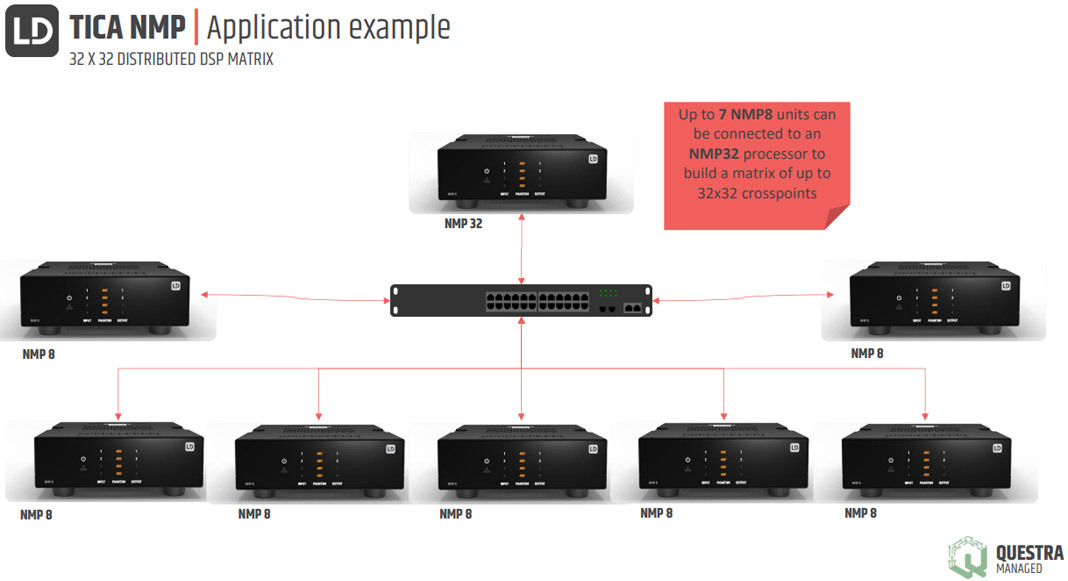
Multiple NMP8 units can be connected to an NMP32 to build distributed systems up to 32×32 and beyond.
NMP8 and NMP32 are not competing products — they are complementary tools.
Together, they offer a flexible, professional solution that adapts to real‑world installation needs instead of forcing customers into a one‑size‑fits‑all processor.
If advanced DSP is required everywhere, NMP8 is the right choice. If large systems need to scale efficiently, NMP32 is the right choice. For many typical installations — for example an 8×8 matrix — combining one NMP8 with one NMP32 allows customers to get the best of both worlds: advanced DSP processing where it matters, together with flexible routing and system scalability.
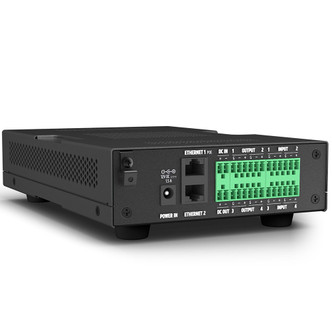
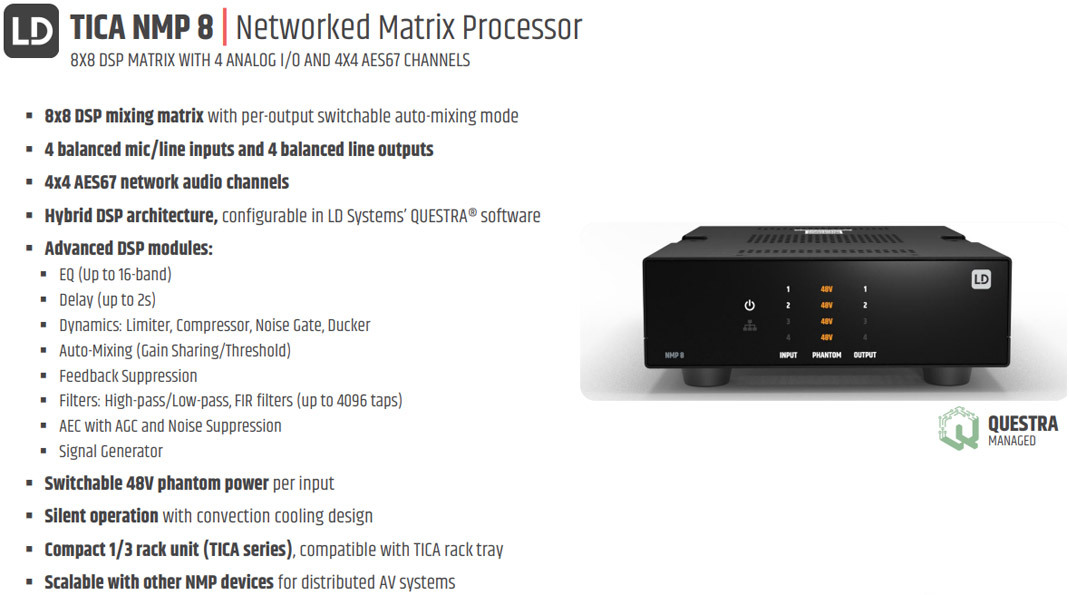
The NMP 8 is a compact 8x8 DSP matrix processor and part of the TICA® Series. It is designed to route, mix and optimise audio across installed, multi-zone AV systems. It has 4 balanced mic/line inputs featuring switchable 48 V phantom power per input, as well as 4 balanced line outputs. This allows it to connect local microphones, media sources, amplifiers and powered speakers in a clean, streamlined setup.
For networked installations, NMP 8 adds 4×4 AES67 network audio channels (Dante-compatible via AES67), enabling open AoIP integration and scalability across multiple rooms and system endpoints.
NMP 8 is perfect for meeting and training spaces, hybrid classrooms, multi-zone hospitality (lobby/restaurant/terrace), and retail or public facilities combining background music with announcements. Audio can be shaped with per-channel DSP tools including EQ, delay, dynamics, and FIR filtering. Integrated functions such as automatic echo cancellation (AEC), gain sharing, gating automixers, feedback suppression and priority ducking can be added to support clear speech and automated mixing.
NMP 8 is fully integrated in QUESTRA® and designed to scale with other QUESTRA-enabled devices. Installation is straightforward: PoE powered (IEEE 802.3af) with optional DC backup, fanless for noise-sensitive environments, and built in a 1/3 19″ rack, 1U format with an optional rack tray for flexible mounting.
The perfect solution for professional installers and users who need a compact platform for multi-zone audio, network audio interoperability, and powerful DSP processing.
- 8×8 DSP matrix for scalable installed and networked AV systems
- Fully integrated in QUESTRA® software with visual workflow
- 4 balanced mic/line inputs and 4 balanced line outputs
- Switchable 48V phantom power per input
- 4×4 AES67 network audio channels for open AoIP integration
- Dante-compatible operation for flexible networked audio connectivity
- Hybrid DSP core with flexible configuration per channel: EQ, delay, dynamics, FIR-filters
- Includes AEC, gain-sharing mixer, gating automixer, feedback supressor and priority ducker
- PoE powered (IEEE 802.3af) with extra DC input for external power supply
- Fanless cooling for noise-sensitive environments
- Small form factor 1/3 19″ rack, 1U
- Optional rack tray for combining with other TICA® series products
General
| Material | Steel sheet |
| Coating | Powder coated |
| Colour | Black |
Inputs
| Input signal type | AES67 |
| Input signal type | Balanced |
| Input signal type | Condenser microphone (phantom powered) |
| Input signal type | Dynamic microphone |
| Input signal type | Unbalanced |
| AES67 Connector type | RJ-45 socket |
| Number of mic/line inputs | 4 |
| Mic/Line-in connector type | Terminal block 3 pin (Euroblock) / 3.5 mm pitch |
| Phantom power | 48 V |
Mic/line input performance
| Nom. Sensitivity (< 1% THD, 1 kHz, max. gain) | 43 mV |
| Gain range | 0 - 24 dB |
| Input impedance | 6.8 kΩ |
| THD+N | ≤ 0.003 % (+4 dBu) |
| Input's frequency response (±0.5 dB, rel. Avg) | 13 - 22,000 Hz |
| Min. SNR (<1% THD, 1 kHz, Max. Gain, unweighted) | 110 dB |
| Min. SNR (< 1 % THD, 1 kHz, unity, A-weighted) | 102 dB |
| Min. CMRR | 50 dB |
AES67
| Number of input channels | 4 |
| Number of output channels | 4 |
| Sample rate | 48 kHz |
| Bit depth | 16 Bit |
| Bit depth | 24 Bit |
| Bit depth | 32 Bit |
Outputs
| Output signal type | AES67 |
| Output signal type | Balanced |
| Output signal type | Unbalanced |
| AES67 outputs connector type | RJ-45 socket |
| Number of line outputs | 4 |
| Line outputs connector type | Terminal block 3 pin (Euroblock) / 3.5 mm pitch |
Line output performance
| Max. output level (<1 % THD, 1 kHz, max. Gain) | 13.5 dBu |
| Balanced output impedance (1 kHz) | 600 Ω |
| Intermodulation distortion (SMPTE) | 0.005 % |
| THD (+4 dBu) | 0.004 % |
| Signal to noise ratio SNR (<1% THD, 1 kHz, unity gain, A-weigthed) | > 95 dBu |
| Dynamic range (AES17) | > 110 dB |
Signal processing
| AD/DA converter bit depth | 24 Bit |
| AD/DA converter sampling rate | 48 kHz |
| System latency | 2.6 ms |
Mains operation
| Operation voltage | 100 V AC - 240 V AC (±10 %) / 50 - 60 Hz |
| Operation voltage | PoE+ (42.5 V DC - 57 V DC, IEEE 802.3at, Type 2) |
| Rated power | 10 W |
| Power consumption in idle mode | 6 W |
Cooling
| Cooling system | Convection cooling |
Environmental
| Ambient temperature | 0 - 40 °C |
| Maximum air humidity (non-condensing) | 85 % |
| Safety Class | Class 3 |
Dimensions & weight
| Width | 142 mm |
| Height | 53 mm |
| Depth | 221 mm |
| Weight | 905 g |
| Crosstalk | 110 dB |